Flora and fauna
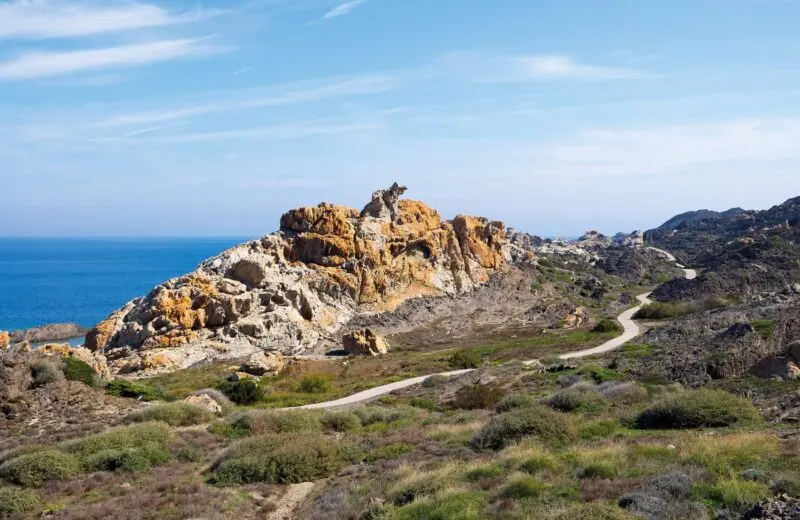
Wild, mountainous land, criss-crossed by small valleys and rivers, speckled with gray, round rocks; Centuries-old Masias, sleepy medieval villages and ancient megalithic culture – the Serra de l’Albera.
The signs of human settlement go back to the Neolithic Age: dolmens and menhires can be found everywhere. Countless small Romanesque churches, chapels, monasteries, castles and palaces are other contemporary witnesses from past eras. The most important buildings include the monastery St Pere de Rodes and the former Benedictine monastery From the 10th century Sant Quirze de Colera, which is currently being restored.
Rocabertí, Requests and Canadal are impressive 14th and 15th century castle ruins.
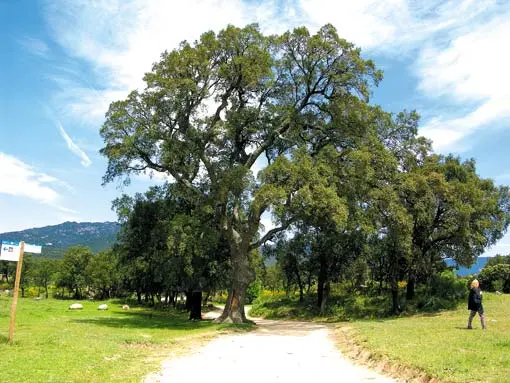 The wild flora and fauna of the Serra de l’Albera is unique. Stone and cork oak forests, pine trees, chestnuts and elms alternate with Mediterranean meadows and shrubs. Numerous animals are hidden in the undergrowth: including wild boars, roe deer, wild cats, golden eagles, falcons, lizards and snakes. To prevent the Greek tortoise from being completely exterminated in the Albera Mountains, the turtle center was founded in Garigulla. Due to its many special features, the Serra de l’Albera Nature Park is to be declared a World Heritage Site by UNESCO this year.
past dolmens and menhirs
Many hiking trails lead through these mountains. One of them through the Estanys de la Jonquera pond area past dolmens and menhirs.
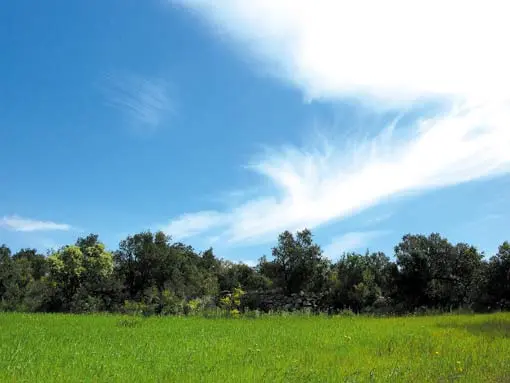
In La Jonquera we turn from the NII to Cantallops. The small road winds up the mountain. After a while we see the hiking sign on the right and park our car. A plaque explains the short circular route to some dolmens. We chose a longer round. According to the plan, our circular route takes about two hours and is easy to walk. We chose sturdy shoes. The landscape has benefited from the rain of the last few days. Green dominated against a bright blue sky.
Wild herbs smell, violet blooms lavender, with yellow gorse and white cistus glow in between. In the background are the mountain peaks of the Serra de l’Albea: Puig Neulós (1,257 m), Puig dels Pastors (1,167 m) and Puig Jorda (753 m). Dry stone walls give the meadows support. Next to the path is the first small pond “Estany Petit”. The water surface is hidden under reeds. The wind is playing with the stalks. Quiet noise reaches the ear. We follow the yellow marking on the left and the sign “Conjunt Megalìtic mas baleta”.
Dull, quiet bells announce a herd of cows. In front of the Mas dels Estanys we meet the peacefully grazing animals accompanied by shepherds, dogs and egrets.
Highlight of the megalithic culture
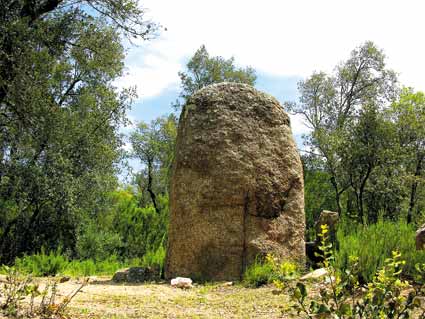
White chamomile flowers, yellow usury flowers and purple thistle flowers adorn the wayside. After a bit of a path, a narrow path branches off to the right up the hill to the Mas Batle. Before the Mas, we follow the signpost to the right to the dolmen. Hidden between idiosyncratic round rocks, we discover the first. The dolmens on the Iberian Peninsula were about 4,000-2,000 BC. built as grave and cult sites. They consist of huge stones and stone slabs and are the highlight of the megalithic culture Dar. We follow the yellow marked path to a small metal bridge over a ditch. Here we make a short detour to the left and meet a stone circle with a menhir in the center. Menhires are upright stones in the middle of the landscape. They can stand individually or in rows or circles as here. They were once social centers and cult facilities. Menhires and dolmens are mostly in strategically or scenically particularly interesting places.
Second, we can only confirm: Away from the world, we seem to have arrived in paradise. Wide landscape, blooming meadows, a romantic stone house, gnarled fig trees. Exalted silence, interrupted by the chirping of the birds. Actually, we want to stay.
Many photos later we continue our hike and walk back to the yellow marking. We follow this until we reach a road.
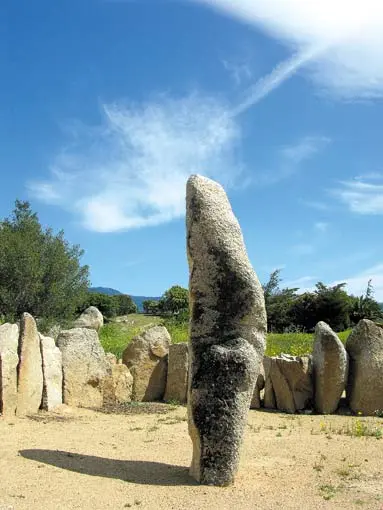 Menhir del Querafumat
There we hike right along the pine forest to a road. About 50 meters to the left we meet the “Menhir del Querafumat”. A huge stone. The marked old forest path now leads us into the forest to a signposted path that turns left past the Menhirs dels Estanys II and I. Then again on the road we come to the dolmen dels estanys II and I. We continue to the left and then follow the narrow path with marked post along the overland line up the hill. At our feet lies the larger of the Estany lakes sunk in the reeds. at “Mirador dels Estanys“The view sweeps far over the landscape to the sea. Cross country the path leads us back down to the parking lot.
For a small lunch we drive the short stretch to Cantallops.
The village of Cantallops is surrounded by dense cork oak forests, sleeping far away from the hasty gear of tourist centers, at the foot of Puig Neulós. The angular bell tower of the church guards the old village houses crouched together. He once served as a defense and watchtower. The Tramuntana often sweeps through the deserted streets. also today. We take refuge in the La Concordia restaurant. Here you get some refined Catalan cuisine, the boss explains to us in German. He has been running the rustic restaurant with his wife for two years. He enthusiastically raves about his adopted home, the Serra de l’Albera, and makes our mouths watery with the description of the preparation of a roast wild boar, the specialty of the house, unfortunately only served in winter. Today we are content with the salad with goat cheese. Next winter we will test the wild boar.
The Serra de l’Albera cast a spell over us. There is still a lot to discover here.
Information and tickets at:
Park Management
C/ Mossen Amadeu Sudrià
3 Espolla 17753
Tel. 972 505 079
Tourist Office La Jonquera