On this page
A walk through Girona with a local: beyond the cathedral
The cathedral is Girona’s great landmark. Its immense Gothic nave is the widest in the world, and the broad staircase seems to draw every visitor towards it. But on this particular day, we are looking for something different. We have arranged to meet our friend Josep beside the Basilica of Sant Feliu, near the River Onyar. He has lived in Girona for years and promises to show us the small corners, stories and details that are easy to miss on a conventional sightseeing tour.
Girona old town at a glance
- Starting point: Plaça de Sant Feliu, beside the basilica and the famous Lioness of Girona
- Highlights: cathedral, Jewish Quarter (El Call), Carrer dels Ciutadans, Rambla de la Llibertat and the city walls
- Suggested time: at least two or three hours for a relaxed stroll, longer with museum and cathedral visits
- Best atmosphere: early morning light or an unhurried afternoon, with time for a café stop
La Lleona: the lioness who promises a return
Josep begins near the entrance to the old town with one of Girona’s most endearing traditions. High on a column stands La Lleona, a replica of a medieval lioness sculpture once associated with an inn near the former town gate. According to the local saying, anyone who kisses the lioness’s backside will return to Girona. Josep tells the story with a smile. It is exactly the sort of detail we would have walked straight past without him.
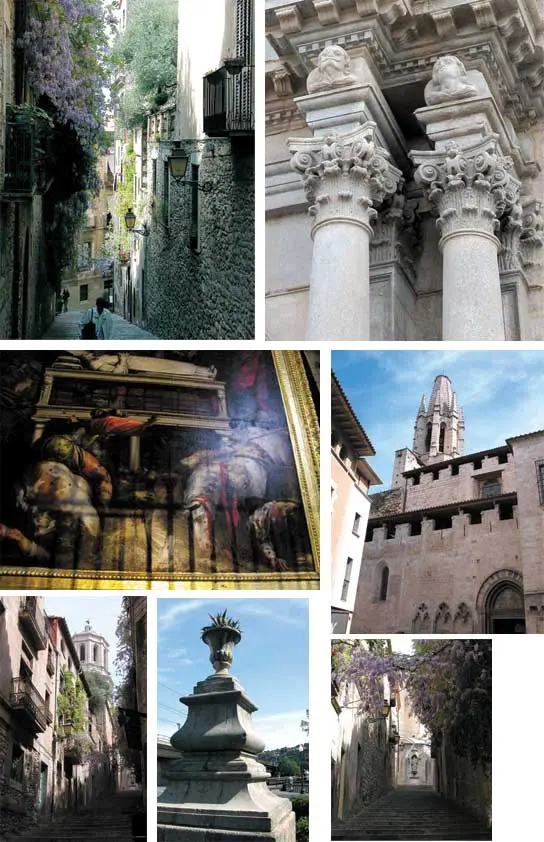
From here we wander into the Carrer dels Calderers, the old coppersmiths’ street, and towards the historic centre. Behind quiet doorways and steep stairways are layers of the city’s long past. Girona has more than two thousand years of history, from its Roman Força Vella to the medieval walls and neighbourhoods.
The cathedral, its staircase and an extraordinary legend
We climb towards the cathedral, pausing every few steps to look back over the rooftops. Inside, the scale of the Gothic nave is astonishing. The great open space is almost 23 metres wide, with no columns interrupting the view. The cathedral’s sculpted stonework and curious gargoyles provide Josep with stories at every turn.
He points out a female figure among the gargoyles and recounts the legend of a woman who threw stones at a religious procession until she herself was turned to stone. Like so many Girona tales, the story makes the old masonry feel alive.
Then comes the legend of Sant Narcís and the flies. According to local tradition, during the French siege of 1285, swarms of flies drove away the invading soldiers. This is folklore, not verified history, and the patron saint’s shrine is particularly associated with the Basilica of Sant Feliu. Josep’s enthusiasm for the story is irresistible; Girona’s legends have fascinated generations of artists and visitors.
El Call: Girona’s Jewish Quarter
A few steps from the cathedral, the lanes narrow dramatically. The Call de Girona is among the best-preserved medieval Jewish quarters in Europe. Along Carrer de la Força, Carrer de Cúndaro and Carrer de Sant Llorenç, stone passages, tiny courtyards and steep stairs reveal a different rhythm of the city. The district bears witness to an important Jewish community whose life here ended amid persecution and the expulsion of Jews from Spain in 1492.
It is tempting to rush from landmark to landmark, but we follow Josep’s slower pace, looking up at old doorways and noticing the changing light on the walls.
Carrer dels Ciutadans, hidden squares and Rafael Masó
We continue along the handsome Carrer dels Ciutadans, once favoured by wealthy merchant families. Old façades and traditional shops give way to the Plaça del Vi and the lively Rambla de la Llibertat. Between the streets, Josep leads us to little squares we would never have found alone, including the tiny Plaça del Raïm.
Girona also has a rich architectural chapter from the early twentieth century. The architect Rafael Masó was a leading figure of Catalan Noucentisme; his buildings add an elegant counterpoint to the medieval lanes. Look for details on façades, balconies and windows as you walk.
End with the city walls and the colourful Onyar houses
From the medieval city walls, the view opens over roofs, church towers and the hills beyond. Back beside the Onyar, Girona’s brightly painted riverside houses make the perfect final scene. We understand why Josep is so attached to this city: it combines history, everyday life, stories and a wonderfully human scale.
Girona is rewarding in every season. In May, the annual Temps de Flors flower festival brings another layer of colour to the old streets. Whenever you visit, allow enough time to lose yourself for a while.
Practical information for your Girona walk
For opening times and admission arrangements at the cathedral and Sant Feliu, check the official cathedral visitor information. The Girona City Council tourism guide covers the historic centre, Jewish Quarter, city walls and houses on the Onyar. Local traditions and their origins are documented by the City of Girona’s legends archive.
Frequently asked questions
What makes Girona Cathedral special?
It contains the widest Gothic nave in the world, a spectacular open space almost 23 metres across.
Where should I start a walk through Girona?
Our personal route begins at Sant Feliu and La Lleona, then climbs to the cathedral and continues through the Jewish Quarter.
What is the story of Sant Narcís and the flies?
It is a famous Girona legend connected with the French siege of 1285 and the city’s patron saint, whose shrine is associated with Sant Feliu.
How much time should I allow?
Plan on two or three hours for the old-town walk, plus additional time for interior visits and a break.
Explore more: Girona: love at first sight, Girona: a living city with history and our Temps de Flors archive.
More about Girona
- Girona – love at first sight
- Temps de Flors – Girona
- Girona Temps de Flors: Flower Festival Guide
- Girona on Foot: Cathedral, Jewish Quarter and Old Town
These stories were written in different years. Historical accounts remain identified as such; check each article for current visiting advice.