nicer the bells Never sound:
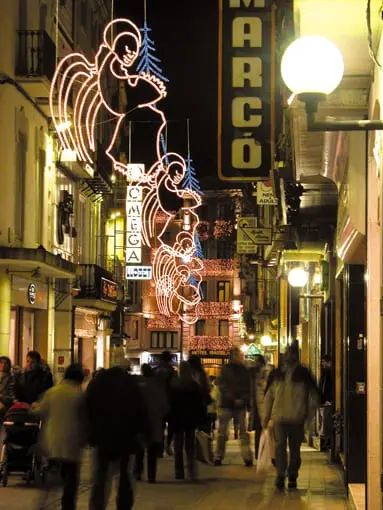
It is said: “One should celebrate the festivals as they fall”. How nice that they are so numerous around the end of the year. First Christmas. Even if the Christian celebration has meanwhile mutated into a major international event, many regions have retained their very own Christmas traditions and customs.
The Catalans prefer to celebrate Christmas with the family. The widely scattered relatives come together from everywhere to celebrate, sing and of course dine together. On Christmas Eve you toasted with cava and then feast extensively: prefers seafood, winged, noble ham, cheese and smoked salmon.
An old tradition is to wear at least one new piece of clothing on Christmas Eve. This promises luck next year. Tradition coupled with a desire to shop today usually leads to a completely new dress. Much to the delight of the boutiques.
The living cribs
Another highlight of the Christmas season are the living cribs, which are staged by the inhabitants in many medieval towns at Christmas in front of an authentic backdrop.
 All villagers are involved in putting their place in Palestine from over 2000 years ago. The “Pessebre Vivent” in Báscara is the best known and particularly impressive every year. Here the living pictures are not only distributed in the medieval village and in front of the castle, but the staging extends down to the river bank of the Fluvià. Pal’s living crib is also one of the most beautiful in the region. Not only the baby Jesus together with his parents and the three kings can be admired. Craftsmen, traders, farmers and jugglers can be admired throughout the village. Everything is festively enlightened. The market hustle and bustle of that time and busy village life are impressively presented. Bread is baked, flax spun, forged, cooked and celebrated. The biblical story can be experienced up close.
The Tió de Nadal in Catalonia
In Catalonia, the “Tió de Nadal” may seem the most exotic. “Tió” is actually the Catalan name for a burning tree stump that brought warmth to the houses in the past – a gift for which one could not be grateful enough. Even if very few people still have a fireplace in the house today, many Catalan families pick up such a tribe during the Christmas season and adorn it with a red nose, coat and cap, reminiscent of the embers of the fire. From December 8th – Día de la Puríssima – he will be fed daily by the children with pumpkins, potatoes and vegetables. On Christmas day, the big hour has come: the “Caga Tió” tumbles gifts from the buttocks under stick hits and the children’s singing, traditionally sweets, small nativity figures and toys, Christmas decorations and now and then a bottle of champagne for the big. If only garlic or an onion finally appear, the poor Tió’s stomach has completely emptied.
After the Christmas holidays, there is little time to catch your breath. Because only a few days later it says: “Feliz año nuevo!”.
 Of course, culinary plays again a major role in Catalonia. We eat with family and friends until shortly before midnight. Not for beginners is the custom of swallowing a grape in each of the last twelve seconds of the year. Each grape stands for a month and promises luck in the new year. Unlike in most countries, board games are brought out instead of fireworks and fireworks or danced until the early hours of the morning.
Gifts are only available on January 6th and not on Christmas Eve.
With the gifts, the time has come in Spain on January sixth. On the Day of the Three Kings, the waiting for the children finally comes to an end.
The kings arrive by camel, train or ship in every city on the evening of January 5th. To give a dignified reception, you play music and accompany the kings in a procession through the city. In joyful anticipation, the children stand on the side of the road and wonder if the kings have received and fulfilled their wish lists?! In Girona, what is probably the most magnificent parade takes place. But in all other cities, too, the three saints walk, ride or drive around and throw sweets to the children.
An old custom is to eat a cake with the family on January 6th. In this is a small king figure and a hard bean. The one who has the figure in his piece of cake may call himself king for a day and put on the attached crown. If you have the bean in your piece, you have to pay for the cake for better or for worse. From January 8th at the latest, everyone will have everyday life back. Until then: Happy Holidays!