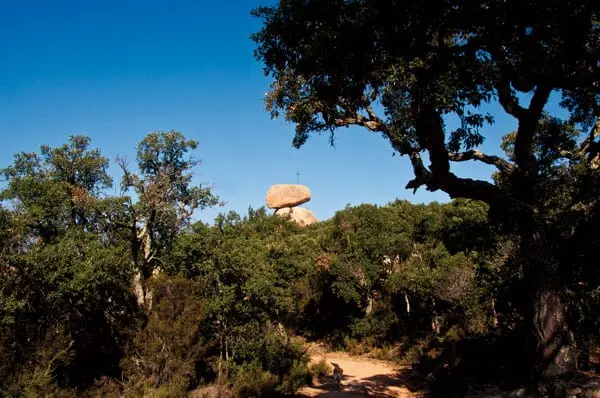
Rocking stones are a natural phenomenon: huge boulders balance, seemingly weightless, on a tiny point of contact. Their puzzling balance has given rise to many legends – some believed they were the toys of giants. One of the largest in Europe stands in the hills above Sant Feliu de Guíxols: the Pedralta.
The Pedralta at a glance
- Location: in the Ardenya massif at around 350 m, on the boundary between Sant Feliu de Guíxols and Santa Cristina d’Aro
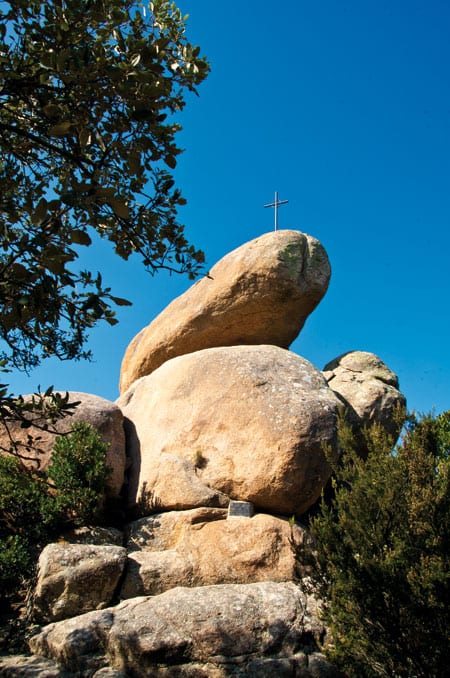
- Size: a granite block about 6 m long, 4 m wide and 3.5 m high
- History: fell in 1996 and was put back in 1999 – it has not rocked since
- Bonus: a viewpoint overlooking the sea and the hinterland
A granite rocking stone
The Pedralta is a granite block estimated at 3.5 metres high, 4 metres wide and 6 metres long. It rests on a base of much smaller stones and also marks the municipal boundary between Sant Feliu de Guíxols and Santa Cristina d’Aro. In 1996 the rock fell from its base; it was raised again in 1999, but lost its ability to rock in the process. It is still well worth a visit – the rock sculpture is impressive.
The viewpoint
A little above the Pedralta is a signposted viewpoint with wonderful views over the sea and the wooded hills. On a clear day it is a real treat.
Getting there and walking
By car, take the southern exit for Sant Feliu de Guíxols and follow the signs for “La Pedralta” up into the hills. A narrow, partly bumpy road climbs about five kilometres through cork and holm oak woodland. If you are a keen walker, it is better to park lower down and hike up: a waymarked path leads from Sant Feliu de Guíxols past the Sant Benet hermitage to the Pedralta.
More: Sant Feliu de Guíxols, Motorbike tour from Sant Feliu de Guíxols to Tossa de Mar.
More about Sant Feliu de Guíxols
These stories were written in different years. Historical accounts remain identified as such; check each article for current visiting advice.