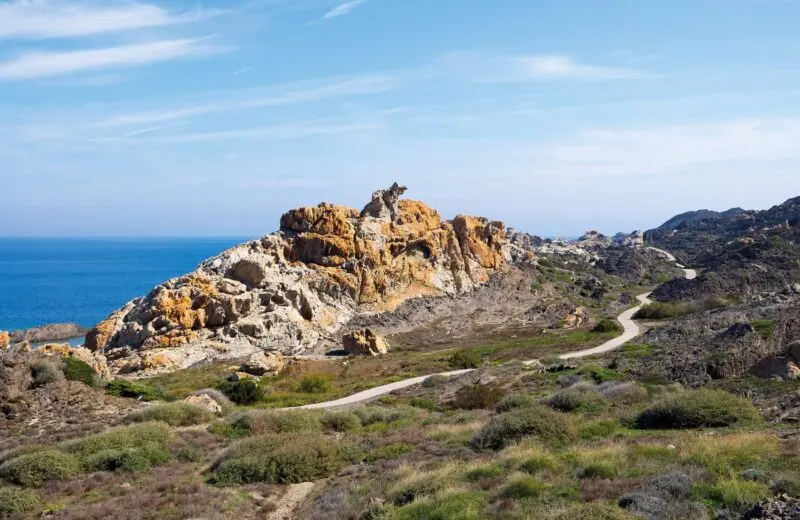
We drive from Cadaqués towards Port Lligat and Casa-Museu Dalí. At the campsite we turn right and follow the road to the parking lot at the bar. From there we continue on foot to the right in the direction of Cadaqués, always along the sea. The path over the partially steep rocks requires safe and sturdy shoes.
We cross a white holiday settlement. The architecture reminds us of old Bauhaus traditions in a straightforward manner and proves once again that in the middle of Mediterranean vegetation with smooth white architectural surfaces, louquet doors and large window areas, you are never bored, but successful contrasts sets. We are already standing at the first rocky bay between agaves and cacti and listen to the cry of the seagulls. The path still winds its way to the next bay.
Here you build flat, spacious bungalows made of natural stone and glass. These, too, fit into the landscape in an exemplary manner and do not obscure the views of the sea and the small, offshore island with a bombastic tower villa for the houses behind them. The small bay with a pebble beach invites you to snip the stones. Our record is eight slips in a row. Satisfied we continue hiking. On the right, a villa replaces the next one and we sneak a little through the gardens of the rich, beautiful and maybe even famous. We would like to have a day of open villas attached to the days of the open monument. But that’s how everything remains anonymous – certainly a good thing – who wants to sit in the Big Brother house. However, the privileged beach house owners share one thing with us: the unique sea view from the Camí de Ronda, on which we hike to Cadaqués. In the next small bay are the fishermen’s scales. Boats gnawed at the ravages of time bob on the beach, and nets and buoys lie scattered. Time seems to stand still here. An old fisherman’s hut ducks on a rocky outcrop. The balcony railing has rusted through, and the remaining struts have been bizarre forms of salt water and wind. In the hut there is a long table and many chairs – but unfortunately it is not a public location for a snack on the way. We continue climbing over the cliffs past cacti and blooming crasa fields, through barren rocks around the next headland and suddenly the white houses of Cadaqués flash in front of us. The Church of Santa María is enthroned above the old fishing village, which is now one of the most expensive refuges on the Costa Brava and is particularly popular with the international art scene, as everyone hopes
a spark of that
to get dalíschen genius. The panorama inspires, and no hotel castle insults the eye. Instead, a pink fairytale castle made of green pine branch shines. Fishing boats bob peacefully anchored on the water between white and red buoy points. Seagulls circle in the wind and we look forward to the colorful activities of the two beach cafés. On the right we discover an abbreviation through the olive groves for our way back. But now we quickly step the last stretch to the place.
Our stomach growls and we hope for tapas to be able to start the march back strongerIn the north-south gradient, the living environment and the artistic work of Bernd Zimmermann takes place. His CV is quickly told and allows little direct conclusions about his art. Born in Ebingen in 1937. Growing up in a family that was characterized by commercial interests, he shows artistic ambitions very early on. With great enthusiasm he modeled and drawn even as a child. His drawing teacher Schwenk gives him the well-intentioned advice when leaving the Ebingen secondary school: “You have talent, use it!”
In the north-south gradient, the living environment and the artistic work of Bernd Zimmermann takes place. His CV is quickly told and allows little direct conclusions about his art. Born in Ebingen in 1937. Growing up in a family that was characterized by commercial interests, he shows artistic ambitions very early on. With great enthusiasm he modeled and drawn even as a child. His drawing teacher Schwenk gives him the well-intentioned advice when leaving the Ebingen secondary school: “You have talent, use it!”
But that could not be said at first. In the difficult time after the Second World War, Bernd Zimmermann was initially unable to realize his wish to become an artist. According to the family tradition, he did a commercial apprenticeship and took over the grandfather’s business. Only gradually was he able to free himself from the economic and financial constraints in order to then deal intensively with the artistic work in his own workshop again from 1975.
The founding of the Paulusgalerie, which has offered many artists a forum since the years of its existence to exhibit their works, also falls during this time. Valuable contacts and fruitful artistic arguments emerged.
From 1978 onwards, there was also a lively exhibition activity at home and abroad.
Bernd Zimmermann has been a member of the Hechingen Artists’ Guild since 1979.
He owes the impetus for the production of woodcuts and important technical help to the Öschinger wood cutter Klaus Herzer.
For Bernd Zimmermann, Corcá, a small, historic village in Catalonia, in northern Spain, has become the second home for Bernd Zimmermann since the early 1980s. There he acquired a house whose age cannot be determined exactly, but whose foundations are probably still of pre-Christian origin. In this magical ambience he gains the creative power to implement his artistic visions. The Mediterranean climate, the fascination of the country and the people, houses and the sea, stimulates sensitivity in a creative way.
It seems to be the appropriate breeding ground that is predestined to produce artists.
Let’s just think of the great Catalans Miró, Dalí, Tapies and others. Art and handicrafts have a tradition in Catalonia.
There are now many friendly relationships with Catalan artists and artistic circles, in which Zimmermann is already so integrated that he has become one of hers.
Heidrun Bucher-Schlichtenberger